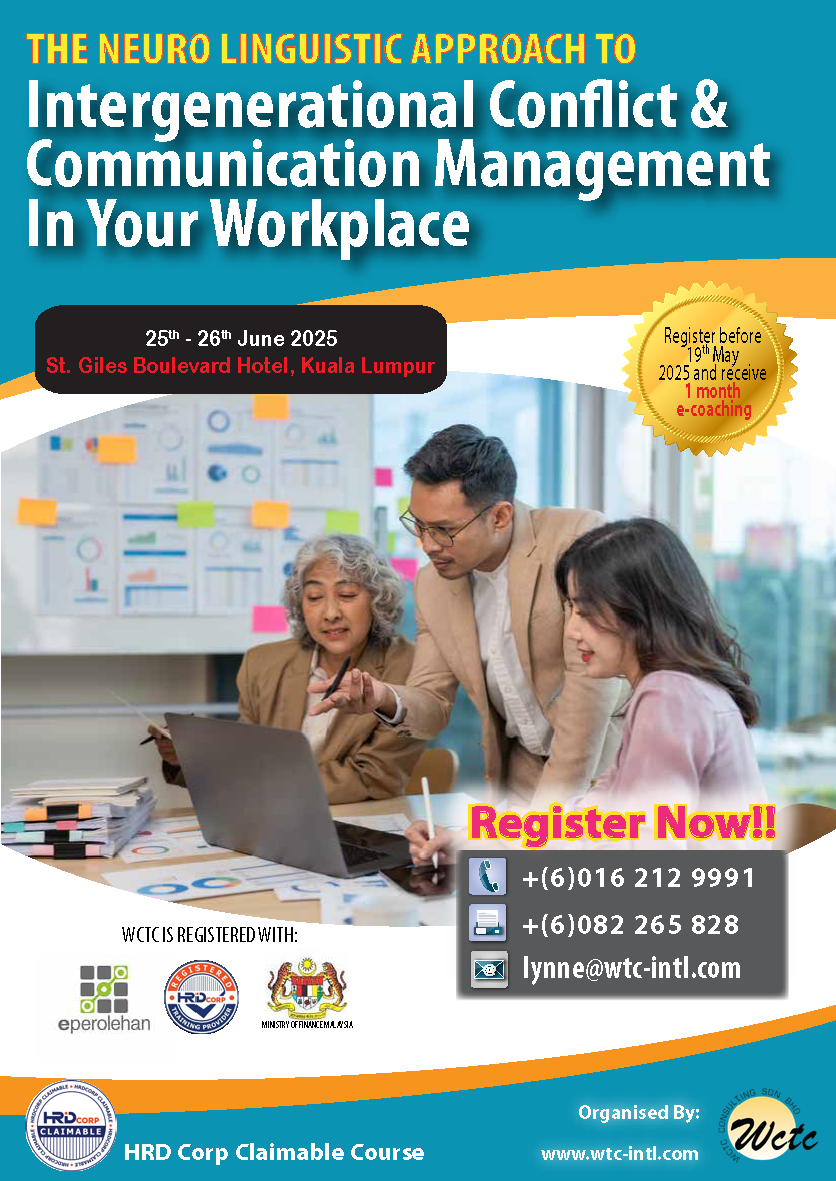
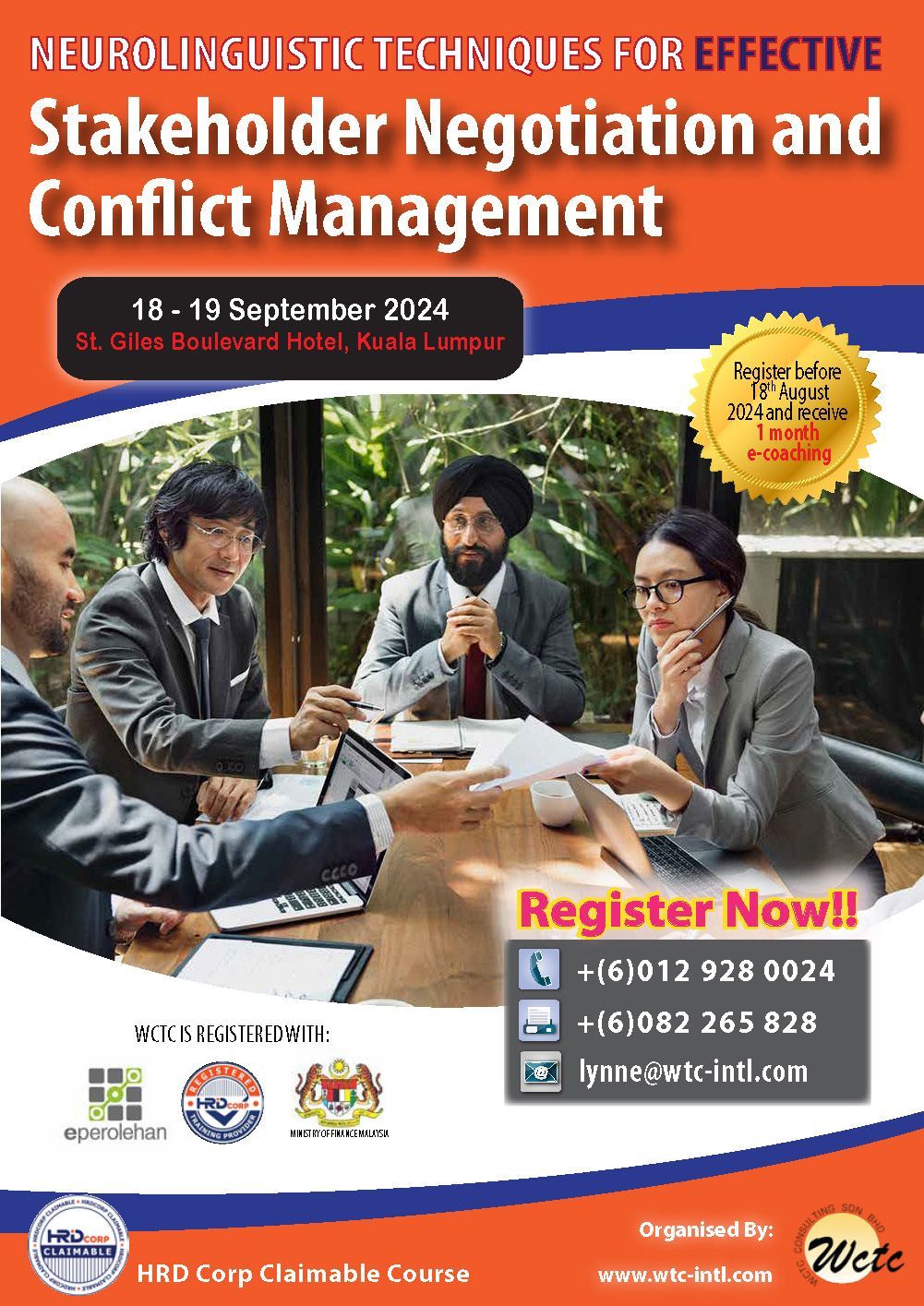
Neurolinguistic Techniques for Effective Stakeholder Negotiation and Conflict Management (18 - 19 September 2024) St. Giles Boulevard Hotel, Kuala Lumpur

OVERVIEW

Effective stakeholder negotiation and conflict management are crucial for organizational success. Neuro-Linguistic Strategies for Stakeholder Engagement and Conflict Resolution leverage the principles of neuro-linguistic programming (NLP) to enhance stakeholder negotiation and

manage conflicts within organizations.


By understanding how language and behavior influence interactions, professionals can apply various techniques to build rapport, communicate effectively, and resolve conflicts constructively. These strategies encompass a range of approaches, including mirroring and matching to establish trust, using persuasive language to influence decisions, and employing reframing techniques to de-escalate conflicts. By integrating NLP strategies into stakeholder engagement and conflict resolution processes, organizations can foster positive relationships and navigate challenges more effectively. These techniques empower professionals to navigate complex interpersonal dynamics with confidence, promoting collaboration, understanding, and mutual respect among stakeholders. Ultimately, by harnessing the power of NLP, organizations can create a culture of effective communication and conflict resolution, leading to improved decision-making, stronger relationships, and enhanced organizational performance.


This program provides participants with practical techniques for understanding and influencing the behavior of stakeholders, enhancing their ability to navigate complex interpersonal dynamics and resolve conflicts constructively. Participants will explore how language patterns and non-verbal cues can be used to build rapport, establish trust, and influence decisions positively. Through hands-on exercises and real-world scenarios, attendees will learn to apply NLP strategies such as mirroring and matching, persuasive language techniques, and reframing to effectively manage stakeholder relationships and conflicts.


PROGRAM HIGHLIGHTS:

  • UTILIZE neuro-linguistic programming (NLP) techniques to enhance stakeholder engagement.
  • DEVELOP skills for building rapport and trust with stakeholders through effective communication strategies.
  • MASTER mirroring and matching techniques to align with stakeholders' communication styles.
  • APPLY persuasive language techniques to influence stakeholder decisions constructively.
  • IMPLEMENT reframing methods to de-escalate conflicts and foster constructive resolutions.
  • NAVIGATE complex interpersonal dynamics with confidence and clarity.
  • INTEGRATE NLP principles into organizational practices for improved decision-making and stronger relationships.
  • PROMOTE a culture of collaboration, mutual respect, and effective conflict resolution within the organization.

CLICK HERE FOR MORE

Other Workshops:

By Rentech Solutions • November 20, 2026
OVERVIEW In today's rapidly evolving business environment, organizations frequently engage in long term partnerships and collaborations with external service providers to meet their operational needs. The protection provided by a well-drafted Services Agreement defines the rights, obligations, and expectations of both parties involved. Top 5 SLA Challenges SLA Performance Issues Changing Business Requirements Disputes and Penalty Enforcement Unclear or Ambiguous Service Level Objectives Misalignment of Expectations between Service Providers and Customers What This Course Offers: By participating in this course, you will gain valuable insights into the fundamental principles, best practicesm and practical strategies for developing and managing effective SLAs. Throughout the course, you will learn how to navigate the complexities of comprehending required clauses, enabling you to develop SLAs that effectively protect the interests of all parties involved. FREE Sample Language For All Sections Of The SLA For Buyer And Service Provider Sample language provided to assist in drafting Sample Language Buyer and Service Provider Clauses and Statement of Works provided. Sample Language for Payment Structure provided Sample Language for Non-Express Warranties / Indemnities and Infringement Indemnities for Buyer and Service Provider Sample Language for Capping of Liability and Carve-Outs provided. Sample Language for drafting Stated Term / Auto Renewal and Fee Increase. FREE Checklists: Buyer Issues Checklists with Embedded Contract Language Service Provider Issues Checklists Quick Reference Service Provider Issue Checklist with Embedded Contract Language Service Level Agreement: Self Assessment Checklist for Organisation SIGN UP with us if you are MAD enough . MAD stands for “Making a Difference” If your organization wants to empower its employees with the knowledge and skills to effectively manage Service Level Agreements (SLAs) and overcome key challenges.
By Rentech Solutions • November 3, 2026
ABOUT THE PROGRAM Be Among the First in Malaysia to Make AI Your Real Workplace Assistant You’re Already Using AI. But Are You Still Doing Most of the Work? You ask ChatGPT, Gemini, Microsoft Copilot or Claude a question. You get an answer. You edit it. You check it. Then tomorrow, you start all over again. Meanwhile, the pressure keeps building more risks to assess, more audit work to document, more reports to produce, more data to analyse and less time to get everything done. If that sounds familiar, simply learning more prompts is NOT the answer. The next leap is learning how to turn GenAI into a REUSABLE PROFESSIONAL WORKFLOW and ultimately, your own AI assistant. FROM “ASK AI” TO “MAKE AI WORK FOR ME” AI-Augmented Risk Management and Internal Audit is an advanced, highly interactive two-day programme designed for professionals who are ready to move beyond basic prompting. Participants will learn how to challenge AI instead of blindly trusting it examining assumptions, exploring alternative scenarios, recognising cognitive bias and applying selected concepts from the DECODA Decision Clarity Architecture (DCA) before accepting AI recommendations. Participants will discover how to transform repetitive work into reusable AI workflows and put GenAI to work across risk identification, risk assessment, risk registers, control recommendations, audit planning, workpapers, executive reporting and fraud risk management. TWO DAYS. ONE BIG SHIFT. By the end of the programme, the goal is no longer: “How do I prompt AI better?” It becomes: “How do I build AI into the way I work without giving up my professional judgement?” The programme culminates in an integrated workplace challenge where participants can design, build and refine their own AI assistant for a recurring professional task from risk and audit reporting to risk registers, audit planning, vendor risk, fraud review or management reporting. AI can generate an impressive-looking analysis in seconds. But would you sign off on it? That is where this programme becomes different. You will also tackle the uncomfortable questions professionals cannot afford to ignore: hallucinations, Validation, confidentiality, data protection, explainability, documentation and AI governance . This is not about replacing the risk manager or internal auditor. It is about creating an AI-augmented professional who can work faster, think critically and make better-informed decisions. And you won’t just watch the trainer do it. You will build it, test it and challenge it yourself. Move beyond prompting. Build reusable AI workflows. Create an AI assistant around the work you actually do. Learn how to harness AI Tools to work faster and smarter while keeping professional judgement firmly in your hands. Do not just chat with AI. Make AI work for you.